

Plaintiff attorneys use a demand letter to open settlement negotiations, document their client’s damages, and signal to the insurance carrier that the case is properly prepared. A poorly drafted or disorganized demand invites a low offer. A well-structured one backed by organized medical records moves cases toward settlement faster and closer to the demand figure.
This article gives you: a reusable personal injury demand letter template built on the exact format our team uses across thousands of PI cases, two fully annotated real-world samples (motor vehicle collision and slip and fall), a ready-to-copy pain and suffering language block, a demand package exhibit checklist, and answers to the questions plaintiff attorneys ask most about demand letters.
The template structure on this page reflects the standard used by plaintiff attorneys handling personal injury, workers’ compensation, and premises liability cases across the United States.
Table of Contents
- What Makes a Personal Injury Demand Letter Work for Attorneys
- Personal Injury Demand Letter Template (Motor Vehicle Collision)
- Pain and Suffering Demand Letter Language: What Works and What Doesn’t
- How Organized Medical Records Directly Affect Settlement Value
- 5 Personal Injury Demand Letter Mistakes That Cost Attorneys Settlements
- Personal Injury Demand Letter FAQ
- Use the Template. Back It With Organized Medical Records!
What Makes a Personal Injury Demand Letter Work for Attorneys
A demand letter accomplishes three things simultaneously: it presents the liability facts in the most favourable light, it documents every category of damages with precision, and it signals to the adjuster that the attorney is prepared to try the case if the offer is inadequate.
The letters that settle quickly and at or near the demand figure share four characteristics:
- Front-loaded demand amount and policy-limits condition: Adjusters route files to the correct authority level before reading details. A $300,000 demand requires a different approval chain than a $30,000 demand. Put the number in paragraph one.
- Clinical injury terminology that matches the medical records exactly: Every diagnosis in the demand should appear verbatim in the attached records. Inconsistency between the demand letter and the records it cites is the fastest way to lose adjuster credibility.
- Specific lifestyle impact language – not general categories: He can no longer perform physical work’ is forgettable. ‘He was unable to complete the flooring job he had been hired to do and can no longer perform the yard work and farm chores that covered his room and board’ is specific, verifiable, and memorable at mediation.
- Organized medical documentation as exhibit-referenced attachments: A medical chronology as a standalone exhibit not raw records lets the adjuster verify the treatment timeline in minutes. Adjusters who have to organize records themselves make conservative assumptions. Organized records remove that variable.
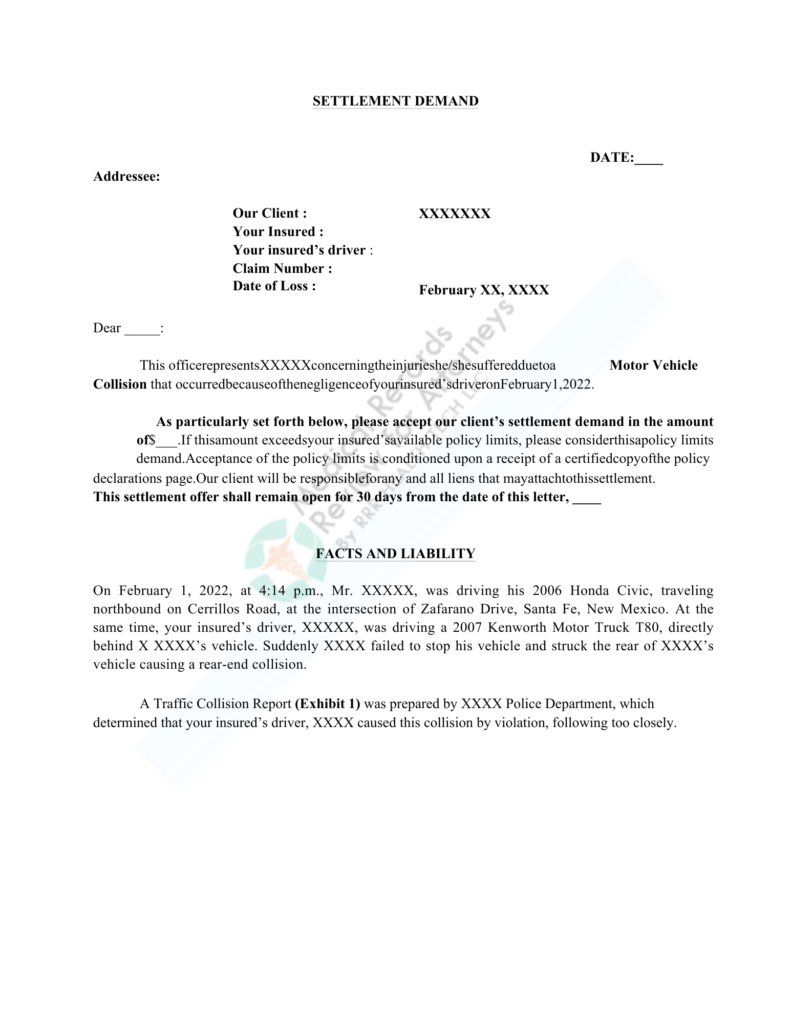
Personal Injury Demand Letter Template (Motor Vehicle Collision)
The sample below uses the exact header format, section order, and policy-limits language from the real MVA demand letters our team supports. The annotations in brackets explain the strategic purpose of specific language choices — useful for attorney review and paralegal training.
Pain and Suffering Demand Letter Language: What Works and What Doesn’t
The lifestyle impact section has the highest return on writing effort in any demand letter. Two sentences of generic language at the end of a ten-page demand give the adjuster nothing to work with and nothing to fear at trial. The table below shows the difference between language that moves reserves and language that doesn’t.
| Weak — Gives the adjuster nothing to work with | Strong — Specific, verifiable, memorable at mediation |
| ‘He can no longer perform physical activities’ | ‘He was unable to complete the flooring job he had been hired to do and can no longer perform the yard work and farm chores that covered his room and board’ |
| ‘Her quality of life is significantly impacted’ | ‘She can no longer provide the grandchild care and school volunteering that defined her daily routine — her grandchildren now attend events she used to organise’ |
| ‘He suffers from ongoing pain and emotional distress’ | ‘He rates his pain at 6-8/10 before physical activity every morning. He has not had an uninterrupted night of sleep since the date of the collision’ |
| ‘She has difficulty with activities of daily living’ | ‘For the first 12 weeks post-surgery she could not drive, cook, or climb stairs without assistance. She required a home health aide six hours per day’ |
| ‘He experiences psychological difficulties’ | ‘He has been diagnosed with PTSD and major depressive disorder by his treating psychologist, Dr. Obi. He is under active psychiatric medication management (Exhibit 10)’ |
How Organized Medical Records Directly Affect Settlement Value
The most common reason a strong case receives a low initial offer is not weak facts — it is disorganized medical documentation. Insurance adjusters process hundreds of claims. When records are unorganized, they take shortcuts. They undercount providers, miss diagnoses, and question causation. Every shortcut moves the reserve number down.
| Without a Medical Chronology | With a Medical Chronology |
| Adjuster spends 2+ hours sorting through raw records | Adjuster verifies the entire treatment timeline in under 15 minutes |
| Missing providers reduce documented medical expenses | Every provider and every dollar is exhibit-referenced and accounted for |
| Treatment gaps create causation doubt | Continuous chronological record closes the causation chain |
| Disorganized records signal an unprepared attorney | Organized package signals a firm ready for trial if needed |
| Low initial reserve based on incomplete picture | Higher initial reserve based on full documented damages |
A medical narrative summary adds a second layer: it translates clinical language into a medical-legal story — how the injury mechanism caused the documented diagnoses, how treatment demonstrates causation, and how pre-existing conditions are distinguished from new injuries. Adjusters are trained to exploit prior history. A narrative summary that addresses it proactively closes that argument before it opens.
5 Personal Injury Demand Letter Mistakes That Cost Attorneys Settlements
Blank fields in the Summary of Damages
Sending a demand with ‘Loss of income: ___’ or ‘Future loss of income: ___’ signals the letter is an uncompleted template. Fill every line. If a category is not applicable, state it explicitly: ‘Past wage loss: Not applicable – claimant is retired.’ Blank lines invite low offers and follow-up requests that delay settlement.
Generic lifestyle impact language
Two sentences of ‘significant pain and suffering’ at the end of a 10-page demand package will not produce a meaningful general damages offer. Name the specific activities lost. Name the job duties the claimant can no longer perform. Reference the sworn statements or physician notes that document the impact. The comparison table in the section above shows exactly what this means in practice.
Disorganized or missing medical documentation
A demand package with records out of order, providers missing from the exhibit list, or billing not matched to specific encounters is processed conservatively. A medical chronology as a standalone exhibit date-ordered, provider-by-provider is the single highest-impact improvement to any demand package. It is the document that lets the adjuster build the same picture you want them to have.
Weak or missing future damages section
Many attorneys document past medical bills thoroughly and then summarize future costs in one vague sentence. Future medical costs, future loss of earning capacity, and future care needs are often the largest component of a serious injury case’s value. Itemize future projections by treatment category, ground each one in a physician recommendation from the existing records, and present them as a range rather than silence.
Not addressing pre-existing conditions proactively
If you do not address prior history in the demand, the defence will use it to undervalue the claim. Adjusters are trained to find the prior MRI, the earlier back complaint, the previous surgery. Address it first: what existed before, what is a new injury from this incident, and what was aggravated. A physician narrative that makes this distinction explicitly removes the defence’s most reliable counter-argument before it is raised.
Personal Injury Demand Letter FAQ
How do you write a personal injury demand letter?
Use the template structure on this page: open with representation and demand amount, state the facts and liability, list injuries using clinical terminology from the records, walk through the treatment chronology with exhibit references, itemise medical expenses by provider, project future costs, document income loss, write specific lifestyle impact language, summarise all damages in a table, and close with the demand, policy-limits condition, and 30-day window. Attach a medical chronology, all billing records, and supporting exhibits.
What is the difference between a car accident demand letter and a slip and fall demand letter?
The structure is identical. The key difference is in the Facts and Liability section: a car accident demand uses the police report, traffic violation citation, and fault determination as the liability foundation. A slip and fall demand uses the incident report, notice evidence (employee admissions, surveillance footage), and premises liability statute as the foundation. The rest of the template — injuries, treatment, damages, conclusion — is the same.
Can a paralegal write the personal injury demand letter?
Yes — paralegals routinely draft the facts, treatment narrative, and damages sections in plaintiff PI firms. The supervising attorney reviews and signs all demand correspondence. Using a firm-wide template makes delegation safe: it ensures the paralegal follows the correct structure on every case. Outsourcing medical records organisation to a specialist review service frees both attorney and paralegal time for the legal and strategic work.
Use the Template. Back It With Organized Medical Records!
The template and samples on this page give you the structure and the language. What determines whether your demand produces a number worth accepting is the quality of the medical documentation package you attach to it.
Adjusters do not undervalue cases because they misread demand letters. They undervalue them because the records do not support the number. A disorganised medical record pile creates doubt. A date-ordered medical chronology, properly indexed and exhibit-referenced, removes it.
The two things that make demand letters work for attorneys — a standardised template that ensures consistency across every case, and organised medical records documentation that closes every door the defence will try to open — are both available as a system. The template is above. The records support is one call away.
Need the Medical Records Behind Your Next Demand?
RRR Health Tech prepares medical chronologies, narrative summaries, billing summaries, and complete demand support packages for plaintiff attorneys across the United States — with 48-72 hour standard turnaround and HIPAA-compliant secure file handling.
- Call: +1-307-462-0555
- Email: support@rrrhealthtech.com
- Submit Documents