
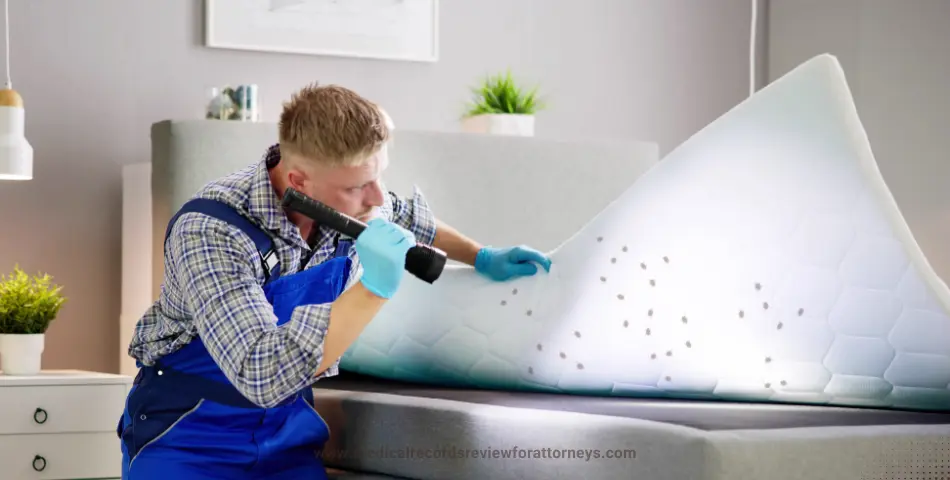
Bed bug premises liability claims are often underestimated – treated as minor nuisance cases rather than what they typically are: negligence claims with clear legal elements, real damages, and case value that depends heavily on how well the evidentiary record is built. This guide covers the legal framework, what actually drives settlement value, how to document a claim so it holds up, and where these cases most often fall apart.
Handling an Active Bed Bug Claim right now?
If you’re currently screening or building a bed bug premises liability case, the sections below on evidentiary documentation and defense counterarguments are the highest-leverage places to start. Or skip ahead – our team can review the medical records you already have and flag gaps before they become a problem at negotiation.
Table of Contents
- Handling an Active Bed Bug Claim right now?
- The Legal Basis for a Bed Bug Premises Liability Claim
- Where These Bed Bug Claims Arise
- What Actually Drives Case Value
- Publicly Reported Settlement Examples
- Building the Evidentiary Record
- Common Defense Arguments — and How to Counter Them
- Statute of Limitations
- Frequently Asked Questions
The Legal Basis for a Bed Bug Premises Liability Claim
Bed bug claims are typically brought as ordinary negligence or premises liability actions, occasionally alongside a breach of the implied warranty of habitability for residential tenancies. Four elements generally need to be established:
- Duty of care: The property owner or operator had an obligation to maintain reasonably safe, pest-free premises for guests, tenants, or visitors
- Breach: The owner failed to meet that duty – commonly through inadequate inspection, ignoring prior complaints, or failing to act on a known infestation
- Causation: A direct link between the infestation and the client’s injuries, connecting the exposure to the documented harm
- Damages: Quantifiable harm – medical costs, property loss, lost wages, or emotional distress
Breach is usually where these cases are won or lost. A property with no prior complaints and a documented, prompt response to a first report is a materially weaker case than one where prior guest reviews, maintenance logs, or complaint records show the owner knew and did nothing.
Where These Bed Bug Claims Arise
The duty owed – and the standard used to judge breach – varies meaningfully by setting:
| Setting | Duty Standard | Key Legal Theory |
| Hotels & short-term rentals | Heightened commercial hospitality duty | Negligence, courts consistently hold operators liable for known or reasonably discoverable infestations |
| Residential rentals | Habitability standard, plus general negligence | Breach of implied warranty of habitability (jurisdiction – dependent) alongside negligence |
| Extended-stay & long-term care facilities | Heightened duty due to resident vulnerability | Negligence, often with a stronger damages argument given limited ability to self-remediate |
| Employer-provided housing / dormitories | General premises duty, sometimes contractual | Negligence, may include a contract or lease-based claim depending on the housing arrangement |
What Actually Drives Case Value
The factors that most consistently move a case’s value:
- Severity and duration of the infestation, and how it’s documented (photos, pest control reports, exterminator invoices)
- Medical treatment required – from topical treatment for bites through documented secondary infection or allergic reaction
- Evidence of prior notice – previous guest complaints, online reviews, maintenance requests, or a documented history of treatment at the same property
- Property damage and relocation costs, where infestation required disposal of belongings or a move
- Emotional distress documentation, particularly where sleep disruption or anxiety symptoms were clinically treated rather than simply alleged
Publicly Reported Settlement Examples
The figures below are drawn from publicly reported, resolved cases and are illustrative only – not a prediction for any specific claim. They’re useful primarily to show how the value drivers above actually play out:
| Amount | Case Summary |
| $10,000 | Guest bitten extensively at a 4-star hotel; the hotel’s own pest control vendor confirmed bed bugs, and a prior guest review documented the same room had bed bugs roughly two months before check-in – strong prior-notice evidence |
| $15,000 | Hotel guest injury claim resolved after documented bite injuries and treatment |
| $26,748 | A couple bitten repeatedly during a stay at a four-star hotel |
| $40,000 | Tenant continued suffering bites over roughly six weeks while the landlord delayed fumigation after being notified – delay itself became central evidence of breach |
| $40,000 | Family of three bitten during a vacation stay at a mid-tier hotel chain |
| $49,800 | Three roommates in a rented apartment where the landlord failed to disclose a known, pre-existing infestation before move-in |
| $90,125 | Family of five in a rental duplex, involving more extensive documented harm and property loss |
Note: severe outlier cases exist well outside this range in both directions — including at least one multimillion-dollar wrongful death settlement tied to extreme, prolonged neglect in an institutional setting. Treat these figures, including the range implied above, as illustrative rather than a guarantee, and avoid citing any number to a client as an expectation rather than a data point.
Building the Evidentiary Record
The strength of a bed bug claim is almost entirely a function of documentation quality, gathered as early as possible:
| Evidence Type | Why It Matters | How to Obtain |
| Photographic evidence | Documents bites, bedding, and visible insects at the time of exposure | Client’s own phone photos, dated and timestamped where possible |
| Pest control / inspection reports | Establishes the infestation was real and often when it began | Request from the property directly, or commission an independent inspection |
| Complaint history | Usually the single strongest evidence for the breach element | Prior guest reviews, maintenance tickets, other tenant complaints, public review sites |
| Complete medical records | Establishes causation and the extent of treatment | Full chronology, not just the first ER or urgent care visit – include any follow-up or referral |
| Financial documentation | Supports property, relocation, and lost-wage damages | Receipts, lease/relocation costs, pay stubs or employer records |
A professionally organized medical chronology that ties treatment dates directly to the incident timeline is often what separates a claim that settles efficiently from one that gets bogged down defending its own causation story.
Handling Medical Record for a Bed Bug Case?
Disorganized or incomplete medical records are one of the most common reasons a strong bed bug claim underperforms at negotiation. Our team builds physician-reviewed medical chronologies that connect treatment directly to the incident timeline — the exact documentation defense counsel looks to poke holes in.
Common Defense Arguments — and How to Counter Them
| Defense Argument | Counter-Strategy |
| “No prior notice of infestation” | Complaint history, online reviews, or a documented pattern of pest issues before this incident directly rebuts this |
| “Pre-existing condition or unrelated dermatological issue” | A clear medical timeline showing symptom onset aligned with the stay or tenancy, ideally supported by a treating physician’s assessment |
| “Client contributed to the exposure” (e.g., brought in infested belongings) | Highly fact-specific; usually turns on whether the property can show it had no prior infestation history – another reason to document the property’s own maintenance record early |
| “Damages are speculative or exaggerated” | Complete, itemized medical and financial documentation removes room for this argument — this is where organized records do the most work |
Statute of Limitations
Filing deadlines for premises liability and negligence claims vary by state, generally ranging from two to four years from the date of injury, with residential habitability claims sometimes following a separate timeline under state landlord-tenant law. Confirm the applicable deadline in the relevant jurisdiction at intake – don’t assume a general personal injury statute automatically applies if a habitability or lease-based theory is also in play.
Frequently Asked Questions
What must be proven in a bed bug premises liability claim?
The same four elements as any negligence claim: the property owed a duty of care, breached it (typically through inadequate inspection or ignoring known infestation), that breach caused the client’s exposure, and the resulting harm is quantifiable.
What evidence most strongly supports the breach element?
Evidence the property knew about the infestation before this incident — prior guest complaints, negative reviews referencing bed bugs, or maintenance records – is typically the single most persuasive piece of evidence in these cases.
How is case value typically assessed in bed bug claims?
Primarily by the severity and documentation of medical treatment, evidence of prior notice to the property, and property/relocation costs. Publicly reported settlements for well-documented cases commonly fall in the low five figures, though case-specific facts – including outlier institutional-neglect cases – can move outcomes well outside that range.
What’s the difference between a bed bug claim against a hotel versus a residential landlord?
Hotels are typically held to a heightened commercial hospitality duty of care. Residential landlords may additionally face a breach of the implied warranty of habitability, which can support a claim independent of a standard negligence theory, depending on the jurisdiction.
How long does a client have to file a bed bug premises liability claim?
It varies by state and legal theory – generally two to four years for standard negligence claims, with habitability-based claims sometimes following a separate landlord-tenant timeline. Confirm the specific deadline in the relevant jurisdiction at intake.
Ready to move a Bed Bug Case forward?
Whether you’re evaluating a new bed bug premises liability referral or preparing an existing case for negotiation, a clear, physician-reviewed medical chronology is often the single highest-leverage document in the file.