

Medical records are created for treatment and billing not for building legal timelines, proving causation, or shaping a case narrative. That gap is exactly why many law firms choose to outsource medical chronology instead of handling complex records in-house.
When done right, outsourcing brings clarity to messy charts, speeds up case preparation, and strengthens leverage during negotiations. This guide breaks down when to outsource medical chronology, the real benefits and costs, and the best practices law firms use to get reliable, litigation-ready timelines.
What Does It Mean to Outsource Medical Chronology?
To outsource medical chronology means assigning the review and organization of medical records to trained medico-legal professionals who create a structured, legally usable timeline of care, injuries, treatments, and outcomes.
Unlike basic chart review, a legal medical chronology focuses on:
- A clear timeline of events
- Causation links between incident and injury
- Gaps, delays, and inconsistencies in treatment
- Case-relevant summaries for personal injury and medical malpractice matters
Instead of digging through hundreds or thousands of pages, attorneys get a clear, referenced roadmap of what happened and when.
Want to See what a Litigation-Ready Medical Chronology looks like?
For a full walkthrough with a real Medical Chronology Example, see our step-by-step Medical Chronology Example Guide.
Why Do Law Firms Outsource Medical Chronology?
Time Efficiency for Case Teams
Organizing medical records can consume hours or days per case. Outsourcing allows attorneys and paralegals to stay focused on strategy, pleadings, discovery, and client communication instead of manual record sorting.
Better Case Clarity
A well-built chronology highlights:
- Injury onset
- Treatment progression
- Complications and outcomes
- Documentation gaps or delays
This directly strengthens demand letters, deposition prep, and settlement positioning.
Consistent Quality at Scale
High-volume personal injury and mass tort workflows often strain in-house teams. Outsource medical chronology follow standardized formats, creating consistent, litigation-ready outputs across cases.
Litigation-Ready Documentation
Clinical notes are written for care, not for court. Legal chronologies are structured for:
- Causation review
- Issue spotting
- Faster evaluation by attorneys and experts
That difference alone can change how quickly a case gains traction.
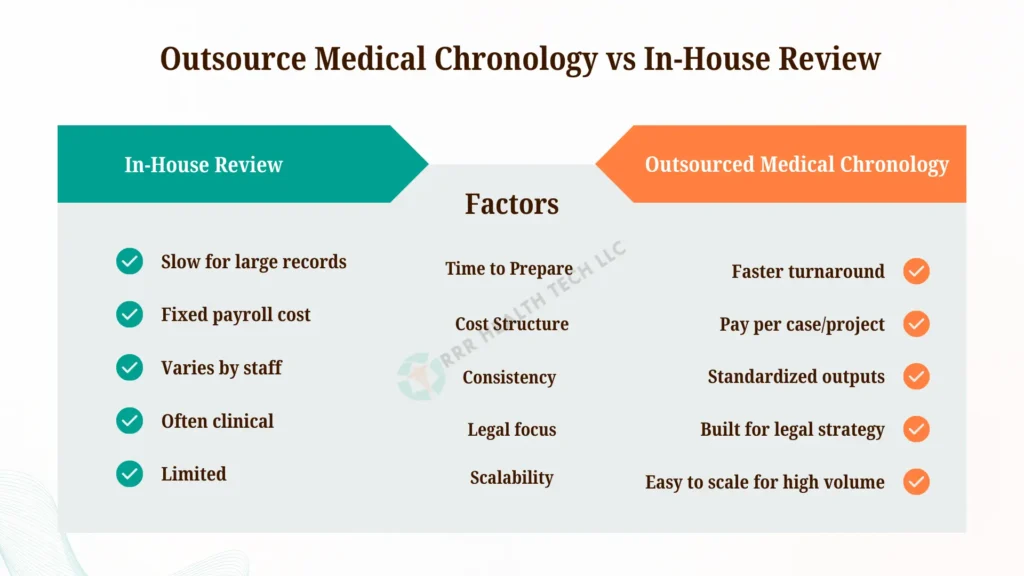
Outsource Medical Chronology vs In-House Review
When in-house makes sense:
- Small caseloads
- Simple, low-volume records
When outsourcing makes sense:
High-volume PI, complex medical malpractice, mass torts, or time-sensitive negotiations.
Cost of Outsourcing Medical Chronology (What Law Firms Should Expect?)
The cost to outsource medical chronology varies based on:
- Medical Record volume (page count)
- Case complexity
- Turnaround time
- Depth of analysis (basic timeline vs causation notes)
Most vendors price per case or per page range. While outsourcing adds a line item cost, firms often find it reduces internal labor hours and speeds up case progression improving overall ROI.
Cost control tips:
- Batch cases for volume pricing
- Request standardized output formats
- Define scope (timeline only vs timeline + issue flags)
Every Case Doesn’t need the Same Level of Medical Analysis
We help firms scope medical chronologies based on record volume, case type, and litigation stage, so you only pay for what you need.
Best Practices to Outsource Chronology Safely
Define Scope Before You Send Records
Clarify whether you need:
- Basic treatment timeline
- Causation indicators
- Gaps and inconsistencies
- Issue flags for litigation
Clear scope prevents rework.
Verify HIPAA-Compliant Handling
Ensure your vendor follows secure data handling, access controls, and confidentiality protocols. This protects client data and firm compliance.
Ask for Sample Outputs
Review a sample chronology format before onboarding. You want:
- Clean structure
- Legal-friendly formatting
- Easy reference to source records
Standardize Turnaround Expectations
Agree on timelines for:
- Standard cases
- Rush cases
- Consistency helps planning and deadlines.
Integrate With Your Case Workflow
Chronologies should plug directly into:
- Demand letters
- Deposition prep
- Settlement evaluation
- Trial strategy
This ensures the output is actually used not just archived.
How to Choose the Right Medical Chronology Outsourcing Partner?
Look for vendors with:
- Experience in legal medical chronology
- Familiarity with personal injury and medical malpractice documentation
- Transparent QA processes
- Secure data handling
- Consistent formatting standards
Avoid vendors that only summarize clinically without aligning to legal causation or timeline needs.
Common Mistakes Law Firms Make When Outsourcing
- Treating chronologies as generic summaries
- Not aligning scope with litigation goals
- Ignoring quality control
- Failing to integrate chronologies into case strategy
- Choosing vendors based on price alone
The value is in clarity and legal relevance, not just speed.
Frequently Asked Questions
Is outsourcing medical chronology HIPAA compliant?
It can be, if your vendor follows secure data handling and confidentiality protocols. Always verify compliance practices.
Does outsourcing medical chronology save time?
Yes. Most firms reduce internal review time significantly, especially for large medical records.
Can outsourced chronologies be used for settlement negotiations?
Yes. Clear timelines and causation summaries improve leverage during negotiations and case evaluation.
Is outsourcing suitable for medical malpractice cases?
Yes. Complex treatment timelines and deviations from standard care benefit from structured chronologies.
When Outsourcing Medical Chronology Makes Strategic Sense?
You should consider medical chronology if your firm:
- Handles high-volume personal injury cases
- Reviews complex medical malpractice records
- Faces tight litigation timelines
- Needs standardized, litigation-ready timelines
Outsourcing doesn’t replace legal judgment, it strengthens it by giving attorneys clearer, faster access to medically structured case facts.
Want to Evaluate Quality before Outsourcing?
We provide personal injury and medical malpractice chronology samples, plus a free consultation to help your team assess fit, scope, and turnaround before you commit.