Introduction
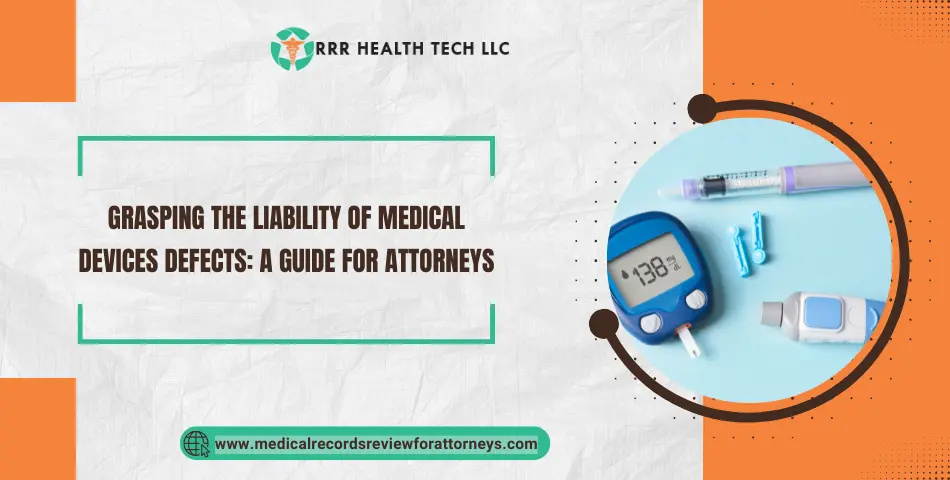
A Medical Device Defects can have serious repercussions for a patient. Such devices lead to injuries and problems for the patient, while also proving to be a legal and financial hurdle for the health care provider, as well as the manufacturer. This article describes the regulations surrounding liability of a defective medical device focusing on the review of medical records, and gives advice for lawyers to take on such challenging cases.
Defective Medical Devices
1.1 Concept and Extent
•Description: A Medical Device Defects when it endangers patient safety due to not working up to full capacity.
•Statistics: In 2022, the U.S. Food and Drug Administration (FDA) reported over 100,000 adverse events concerning medical devices, indicating that there are widespread problems.
1.2 Generic Forms of Medical Device Defects
•Implants: Other invasive devices like Pacemakers and Hip replacements can also malfunction, resulting in catastrophic outcomes.
•Surgical instruments: Even surgical instruments can contain defects, and pose a risk of causing injury during surgery.
•Diagnostic devices: Correct diagnostic devices are very critical. Devices that give inaccurate readings can result in misdiagnosis and wrong treatment being administered.
Legal Aspects for Medical Device Defects
2.1 Important Legal Ideas
Negligence: Failure to ensure that a device is safe and serves its intended purpose can result in the manufacturer being held liable.
Strict Liability: This principle holds that a manufacturer can be sued for a defective product and is responsible for damages without proof of fault.
2.2 Common Legal Claims
• Design Defects: These are flaws that make the device unsafe by design.
• Manufacturing Defects: These are defects that happen during the manufacturing process because of shoddy workmanship, resulting in unsafe devices.
• Failure to Warn: Absence of adequate instructions or appropriate standards that caution against the dangers posed by the use of the apparatus.
The Role of Medical Records Review in Defective Device Cases
3.1 Importance for Attorneys
- Overview: Medical records review serves as the basis for proving a causal link between an injury and a device for a liability claim, thus, preparing them for trial.
- Process: This entails studying the medical histories, treatment records, and outcomes of the patient in regard to the device.
3.2 Key Components of Medical Records Review
- Injuries Recollection: Documenting the type and degree of injuries incurred due to a Medical Device Defects
- Treatment History: Evaluation of the chronology of the device’s use and the medical procedures undertaken to rectify its complications.
- Patient Outcomes: Assessing the consequences of injuries on the patient’s normal functioning and day-to-day activities.
3.3 Challenges in Medical Records Review
- Information Retrieval: Obtained records of patient’s charts make in depth surgical procedure reporting lengthy and impractical.
- Legal Compliance: Obtaining patient information under HIPAA regulations while maintaining privacy.
Case Studies in Medical Device Defects Liability
4.1 Case Study 1: Hip Implant Failure
- Overview: An already complicated patient underwent hip replacement surgery and developed even more complications from a recalled hip implant.
- Challenges: Proving that the patient’s complications stemmed from the implant surgery.
- Solutions: Conducting a better analysis of medical histories uncovered a trending rage of similar aggravating complaints from other patients which vindicated the assertion.
4.2 Case Study 2: Faulty Pacemaker
- Overview: A patient developed cardiac complications as a result of a faulty pacemaker.
- Challenges: Proving the existence of a defect in the device and that the necessary warnings were not provided.
- Solutions: An analysis of the patient’s medical records prior to the device’s implantation coupled with a certain timeline detailed prior medical procedures revealing his failing health post-implant aided establishing the claim.
Current Trends and Statistics in Defective Medical Device Cases (2024)
5.1 Increased Coverage and Associated Legal Action
- Statistics: New reports reveal a 25% surge in lawsuits pertaining to defective medical devices within the last year.
5.2 Changes in Governing Policies
- Trends: Increases in litigation surrounding the medical-legal interface has shifted policies towards safeguarding monitoring of medical devices.
5.3 Changes in Technology
- Innovations: The new technologies in the fields of medicine are improving the safety features. However, these innovations may pose new risks that can potentially lead to liability claims.
Conclusion
Attorneys dealing with complex cases involving defective medical devices, understanding the liability issues are pivotal. Through the analysis of medical records and knowledge of current trends, attorneys can easily defend their clients and ensure that justice is served in the form of adequate monetary compensation.