

Medical Chronology for Medical Malpractice Cases with a Mini Sample
Let’s begin with a real-world example. Below is a Medical chronology example or sample from a medical malpractice cases. This demonstrates how raw medical records are transformed into a litigation-ready timeline.
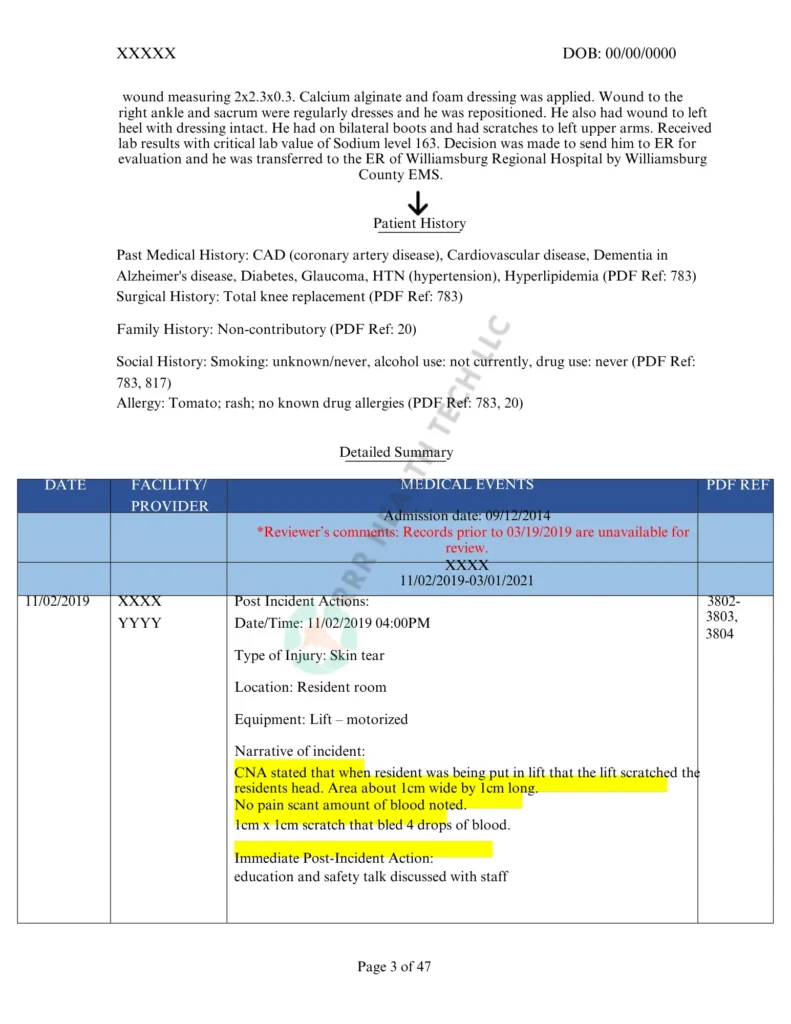
Why this matters: This format allows attorneys to immediately spot the 6-week gap between initial symptoms and definitive testing, a potential deviation in the standard of care.
What Is a Medical Chronology?
A medical chronology is a date-ordered summary of a patient’s medical records, created to support legal case evaluation. Unlike a full medical record dump, a chronology extracts only the information relevant to the legal issues at hand.
Medical Chronology Example: Key Elements
- Exact dates of service or events
- Source identification (provider name, facility, document type)
- Objective findings (test results, vital signs, imaging reports)
- Provider actions (medications ordered, procedures performed)
- Analytical notes linking events to case theories
Need Medical Chronology for an Active Case?
Our team prepares Attorney-Ready Chronologies tailored to Medical Malpractice, Personal Injury, and Mass Tort Litigation.
Note: Keep reading for free templates and examples.
Medical Chronology vs Medical Summary
| Format | Date-by-date log | Narrative overview |
| Purpose | Fact-checking, deposition prep | Settlement brochures, expert review |
| Length | Can be 10–50+ pages | Usually 2–10 pages |
| Best For | Identifying gaps and delays | Telling the patient’s story |
Most attorneys use both: a chronology to investigate the facts, and a summary to communicate the case.
Why Do Attorneys Need a Medical Chronology?
1. Identify Deviations in Care
A well-structured chronology reveals whether a provider acted within the standard of care. For example, did a specialist fail to follow up on an abnormal lab result? A chronology makes this visible.
2. Prepare for Depositions and Trial
Depositions require command of the medical record. With a chronology, you can instantly locate every mention of a specific medication, symptom, or provider.
3. Communicate with Experts
Medical experts do not have time to read 2,000 pages of records. They rely on chronologies to understand the case quickly and form opinions on causation and negligence.
4. Support Settlement Negotiations
A clear, professional chronology demonstrates to defense counsel and insurers that you have thoroughly analyzed the case. This can drive higher settlement offers.
5. Save Time and Reduce Costs
Using a medical chronology template or outsourcing to medical chronology services can reduce record review time by 50–70%.
How to Prepare a Medical Chronology: Step-by-Step
Based on search trends for how to prepare a medical chronology, here is the exact process used by professional chronologists.
Step 1: Gather and Organize Records
- Obtain all medical records, billing statements, and correspondence
- Sort them by date and provider
- Identify any missing records (gaps are often key to the case)
Step 2: Identify Key Data Points
Not every entry matters. Focus on:
- Dates of service
- Diagnoses and test results
- Medications and dosages
- Referrals and consultations
- Hospital admissions and discharges
- Any mention of symptoms or complaints
Step 3: Choose Your Format
Will you use a simple spreadsheet, dedicated medical chronology software, or an AI medical records summary tool? The format should match the complexity of the case.
Step 4: Build the Timeline
Create rows for each relevant date. Include:
- Source document name
- Description of the event
- Clinical findings
- Your own notes or analysis
Step 5: Review for Accuracy
Cross-check every entry against the source record. Even one incorrect date can undermine credibility.
Step 6: Add Hyperlinks (If Using Software)
Modern medical chronology AI tools allow you to link each row directly to the source PDF. This is invaluable during deposition prep.
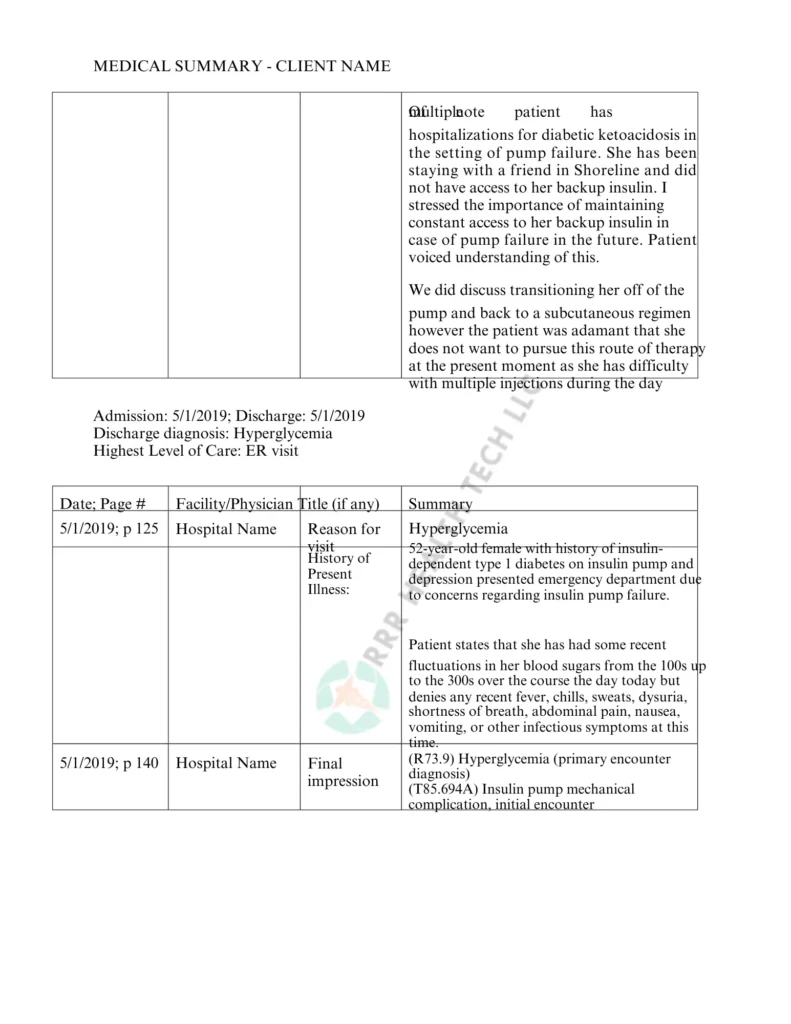
Medical Chronology for Personal Injury and Mass Tort Cases with a Mini Samples
Download our Free Medical Chronology Samples

Medical Records Chronology: Common Mistakes to Avoid
Inconsistent Date Formatting
Use YYYY-MM-DD consistently. Do not mix “01/02/2024” and “Jan 2, 2024.”
Omitting Source Attribution
Every entry must state where the information came from (e.g., “Dr. Jones Office Note,” “L&D Triage Record”).
Including Irrelevant Details
A dental cleaning note has no place in a cardiac malpractice chronology.
Failing to Note Gaps in Records
If medical records are missing, note it. A gap may be evidence of spoliation or poor recordkeeping.
No Analytical Commentary
A chronology is not just a list. Brief notes linking events to case theories add enormous value.
Medical Chronology AI vs Human Review: What Attorneys Need to Know
With the rise of medical chronology AI and AI medical records summary for lawyers, many firms are exploring automation. Here is a balanced view:
Benefits of AI-Assisted Chronology
- Speed: AI can process 1,000 pages in minutes
- Cost: Lower upfront cost than human review
- Consistency: Follows the same rules every time
Limitations of AI Chronology
- Context blindness: AI may miss subtle clinical nuances
- Error rates: AI can misinterpret handwriting or complex terminology
- No legal judgment: AI cannot assess case strategy
Best Practice: Hybrid Approach
Use AI medical chronology tools for initial drafting, then outsource medical chronology reviewer to validate and annotate the output.
Frequently Asked Questions
How do I create a medical chronology template?
Open a spreadsheet and create columns for Date, Source, Event Description, Findings, and Notes. Save it as a master copy. For a ready-to-use version, download our free medical chronology template above.
How long should a medical chronology be?
There is no set length. A simple personal injury case might require 5–10 pages, while a complex malpractice case with thousands of pages of records could require 50+ pages.
How do I include healthcare provider findings in a chronology?
List the provider’s objective findings (test results, vital signs) and subjective findings (patient complaints) in a dedicated column. This helps establish the medical basis for the case.
Conclusion
A well-prepared medical chronology is more than a list of dates, it is a strategic tool that reveals deviations in care, supports expert opinions, and strengthens settlement positions.
By using the medical chronology example, templates, and step-by-step instructions in this guide, you can:
- Reduce record review time
- Identify negligence faster
- Present clearer cases to experts and juries
Stop Building Medical Chronologies Alone!
You’ve seen the Medical Chronology Examples and Downloadable Templates. But some cases need more deeper analysis, faster turnaround, or Expert Medical Records Review. Upload your Medical Records securely. We’ll review them and provide a free timeline estimate within 24 hours.