
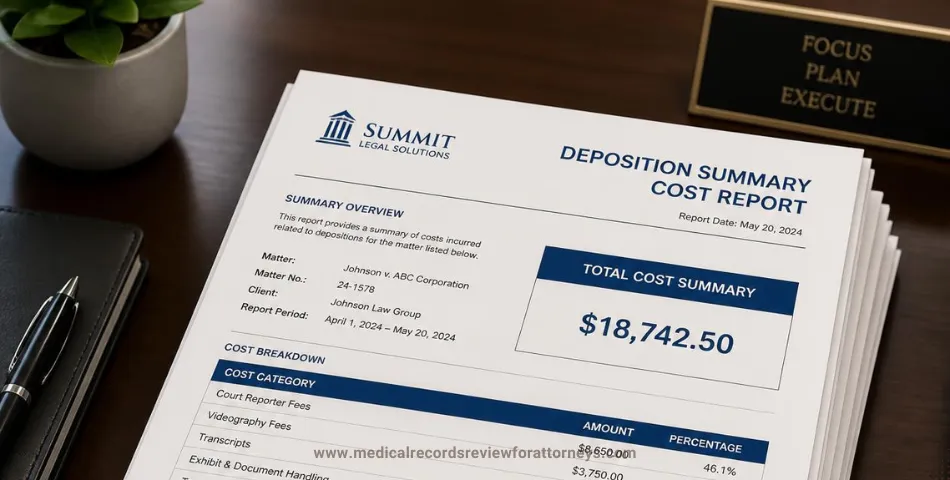
Depositions generate hundreds, sometimes thousands, of pages of testimony and every one of those pages has to be reviewed before it’s useful for trial prep, motion practice, or settlement negotiations. That’s why most plaintiff firms eventually ask the same question: what does a deposition summary cost, and is outsourcing it worth the money?
The honest answer is that pricing varies by page count, complexity, turnaround time, and whether you go with a human-prepared summary, an AI tool, or a hybrid of both. Below is a breakdown of what drives deposition summary costs in 2026, how outsourcing compares to handling summaries in-house, and what plaintiff firms should weigh beyond the price tag.
Skip the Guesswork – Get a Flat-Rate Quote
Tell us your transcript page count and format needs, and we’ll send a straightforward flat-rate quote – no per-page surprises.
- Skip the Guesswork – Get a Flat-Rate Quote
- What Drives Deposition Summary Cost
- Common Deposition Summary Pricing Models
- In-House vs Outsourced: A Real Cost Comparison
- Get Predictable, Flat-Rate Deposition Summary Pricing
- AI vs Traditional Human Summary Pricing
- Deposition Summary Cost by Format
- Deposition Summary Costs in Mass Tort and MDL Litigation
- What to Look for Beyond Price
- Frequently Asked Questions
- How much does a deposition summary cost per page?
- Is outsourcing deposition summaries worth it for law firms?
- How much does it cost to outsource a deposition summary versus doing it in-house?
- What’s the cost difference between AI and human deposition summaries?
- How does turnaround time affect deposition summary pricing?
- The Bottom Line
- Ready to See Exact Pricing for Your Case?
What Drives Deposition Summary Cost
Deposition summary costs aren’t flat across the industry – a handful of factors determine where a given transcript falls within the typical range.
- Per-Page Rate: Most outsourced services price by the page, typically $3 to $8 per page depending on the provider and format.
- Transcript Length: A 100-page deposition costs far less to summarize than a 500-page one, so total cost scales with volume.
- Case Complexity: Depositions involving expert witnesses, technical testimony, or medical experts – common in mass tort and medical malpractice litigation – typically cost more due to the subject-matter review required.
- Turnaround Time: Standard delivery is priced into the base rate; rush or expedited requests add a premium (more on this below).
- Summary Format: Page-line, topical, and chronological formats each involve different levels of drafting effort, which can affect quoted pricing.
If you’re comparing quotes, ask each provider to confirm which of these variables their per-page rate already includes and which ones are billed as add-ons.
Common Deposition Summary Pricing Models
Providers generally price deposition summary work one of three ways, and it’s worth knowing which model you’re being quoted before you compare numbers side by side.
- Per-page pricing: The most common model. You pay a flat rate for every page of the transcript, regardless of how dense or sparse the testimony is on a given page.
- Flat-Fee-Per-Deposition Pricing: Some providers quote a single price for the entire transcript after reviewing its length and complexity up front, which can simplify budgeting for firms that dislike per-page variability.
- Hourly Pricing: Less common for outsourced services, but this is effectively what you’re paying when a paralegal or associate handles the summary in-house – hourly rate multiplied by however long the transcript takes to work through.
Per-page and flat-fee pricing are the easiest to budget against a caseload, since the cost is knowable before work begins. Hourly-equivalent pricing – whether that’s in-house staff time or a provider that bills by the hour – is harder to predict and can run higher than expected on dense or multi-witness transcripts.
In-House vs Outsourced: A Real Cost Comparison
The sticker price of outsourcing can look like an added expense until it’s weighed against what an in-house summary actually costs in staff time.
In-House Cost
A paralegal or associate billing $45 to $65 an hour can spend anywhere from 8 to 15 hours summarizing a single lengthy deposition transcript, depending on complexity. On a 300-page transcript, that’s easily $500 to $900 in internal labor cost – before accounting for the fact that those hours weren’t spent on case strategy, client communication, or other billable work.
Outsourced Cost
A flat per-page rate makes the true cost predictable up front. For the same 300-page transcript at $3 to $8 per page, outsourced pricing runs roughly $900 to $2,400 – comparable to or sometimes higher than the raw in-house labor cost, but without consuming staff hours that could go toward higher-value work.
Where Outsourcing Tends to Win
For firms handling a steady caseload – particularly plaintiff firms managing multiple mass tort or MDL matters at once – outsourcing scales more predictably than adding internal headcount. Flat-rate pricing also makes it easier to budget for deposition summary costs across an entire caseload rather than estimating hours case by case.
Cost Comparison at a Glance
| Model | Typical Cost | Turnaround | Accuracy / Review | Best For |
| In-house (paralegal/associate) | $45–$65/hr (~$500–$900 per 300-page transcript) | Depends on staff bandwidth | High, but time-constrained | Low-volume firms with spare capacity |
| Traditional outsourced (human) | $3–$8/page (~$900–$2,400 per 300-page transcript) | Standard, ~5–7 business days | High – attorney-trained review | Firms wanting predictable flat-rate billing |
| AI-only tool | $30–$100/mo subscription, or ~$1/page | Fast, often same-day | Requires manual verification | Occasional users comfortable self-reviewing |
| Hybrid (AI + attorney review) | Comparable to traditional outsourced, sometimes lower | Faster than fully manual | High – AI speed with human verification | High-volume plaintiff firms, mass tort/MDL caseloads |
The hybrid model tends to land in the sweet spot for firms handling volume: it doesn’t cost meaningfully more than traditional outsourcing, but it moves faster and still carries the accuracy safeguard of a trained human reviewer — something an AI-only subscription can’t guarantee on its own.
Get Predictable, Flat-Rate Deposition Summary Pricing
Skip the per-page guesswork. Our attorney-trained team delivers accurate, HIPAA-compliant deposition summaries at a flat rate – no rush surcharges hidden in the fine print.
AI vs Traditional Human Summary Pricing
AI-powered deposition summary tools have become common in the last two years, and their pricing model looks different from traditional per-page services.
- Standalone AI subscription pricing typically runs $30 to $100 per month, or a low per-page rate in some cases.
- That pricing is attractive on paper, but AI-generated summaries still require an attorney or trained reviewer to verify accuracy, confirm citations, and catch nuance the software may have missed – particularly in testimony involving qualifiers, contradictions, or medical terminology.
- Once that review time is factored back in, the real cost of an AI-only summary is often closer to a hybrid model than the subscription price suggests.
A hybrid approach – AI-assisted extraction paired with review from an attorney-trained team – tends to offer the best balance: faster turnaround than a fully manual summary, with the accuracy safeguards that pure AI output doesn’t provide on its own. This is the model most plaintiff firms should evaluate providers against, rather than comparing AI subscription price to per-page human pricing in isolation.
Deposition Summary Cost by Format
Format also plays a role in pricing, since page-line, topical, and chronological summaries involve different levels of drafting effort. A page-line summary is generally the most straightforward to produce, while a topical summary organized around specific issues – useful for motions or trial arguments – can take more time to prepare well. For a full breakdown of when to use each format, see our guides on page-line deposition summaries and topical drafting strategy.
Deposition Summary Costs in Mass Tort and MDL Litigation
Mass tort and MDL litigation change the cost math in a way single-plaintiff personal injury cases don’t. Bellwether discovery alone can generate dozens of depositions across multiple plaintiffs, defense witnesses, and corporate representatives – sometimes running to thousands of combined transcript pages before a single trial date is set.
At that volume, per-page pricing differences of even a dollar or two compound quickly across a docket, and turnaround delays on individual summaries can bottleneck an entire litigation team’s trial prep schedule. Firms handling high-volume mass tort caseloads typically see the most value from providers that offer:
- Volume-based flat-rate pricing rather than a single per-page rate applied uniformly across every transcript, regardless of case count.
- Consistent formatting across summaries prepared by different reviewers, so co-counsel and trial teams can cross-reference witness testimony without relearning a new layout each time.
- A dedicated point of contact who understands the litigation’s case theory well enough to flag recurring themes across depositions – not just a rotating queue of unfamiliar reviewers.
For firms running several MDL matters simultaneously, the cost conversation is less about the price of any single summary and more about whether the provider can scale without sacrificing consistency or turnaround.
What to Look for Beyond Price
The lowest quote isn’t always the best value. Before choosing a provider, plaintiff firms should confirm the following:
- HIPAA-compliant handling of any medical testimony or records referenced in the deposition, with secure transfer through a compliant portal.
- Attorney-trained reviewers involved in the process, not a purely automated output with no human verification.
- A clear accuracy guarantee or revision policy in case corrections are needed.
- Flat-rate pricing that removes the uncertainty of variable in-house labor costs, especially for firms managing a high-volume caseload.
Frequently Asked Questions
How much does a deposition summary cost per page?
Most outsourced deposition summary services charge between $3 and $8 per transcript page, depending on the format requested, transcript complexity, and turnaround time. A typical 300-page deposition transcript generally runs $900 to $2,400 to summarize when priced per page. Firms that request rush turnaround or highly technical testimony, such as expert medical witness depositions, should expect pricing toward the higher end of that range.
Is outsourcing deposition summaries worth it for law firms?
For firms handling more than a handful of depositions per month, outsourcing is usually the more cost-effective option once you account for paralegal or associate hourly rates. A senior paralegal billing $45 to $65 an hour can easily spend 8 to 12 hours summarizing a single lengthy deposition – time that could otherwise go toward billable case strategy work. Flat per-page outsourcing pricing removes that variability and frees up in-house staff for higher-value work.
How much does it cost to outsource a deposition summary versus doing it in-house?
In-house cost is a function of hourly rate multiplied by hours spent, which varies case to case and is easy to underestimate. Outsourced pricing is typically flat and predictable per page, which makes budgeting easier across a caseload. For high-volume plaintiff firms handling mass tort or MDL litigation, the outsourced model tends to scale more predictably than adding internal staff hours.
What’s the cost difference between AI and human deposition summaries?
Standalone AI summarization tools are usually priced as a monthly subscription, often in the $30 to $100 range, or on a low per-page rate. That pricing looks appealing on paper, but AI-only output still requires an attorney or trained reviewer to verify accuracy before it’s used in motions or trial prep – which adds hidden review time back into the cost. A hybrid model, where AI-assisted drafting is paired with an attorney-trained reviewer, tends to land in the middle: faster than a fully manual summary, but with the accuracy safeguards AI alone doesn’t provide.
How does turnaround time affect deposition summary pricing?
Standard turnaround is typically priced into the base per-page rate, while rush or expedited requests – delivery within 24 to 48 hours – commonly add 25% to 50% to the total cost. Firms preparing for an upcoming trial date or motion deadline should factor rush pricing into their budget early rather than requesting expedited service at the last minute.
The Bottom Line
Deposition summary costs come down to a handful of predictable variables – page count, complexity, turnaround, and whether the work is done in-house, by AI alone, or through a hybrid model. For plaintiff firms juggling a steady caseload, especially in mass tort and MDL litigation, a flat-rate outsourced summary with attorney-trained review typically offers the most predictable cost and the least risk of errors slipping into trial prep.
Before signing off on a provider, get a clear quote in writing and confirm what’s included – turnaround time, format, revision policy, and whether the price is truly flat or subject to add-on fees for rush requests or complex testimony. A provider that can answer those questions clearly, without vague per-page ranges, is usually the one worth trusting with your next deposition.
Ready to See Exact Pricing for Your Case?
Send us your transcript details and we’ll provide a flat-rate quote within one business day.